

INTERVIEW
IN CONVERSATION WITH
MIREILLE GANZIN AND
ALDRIN RODRIGUEZ
THE PAST, PRESENT AND FUTURE OF AEROBIC GYMNASTICS
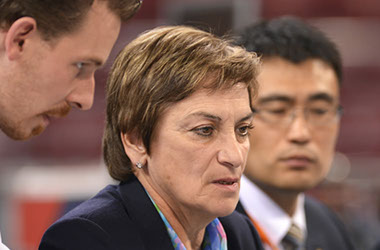
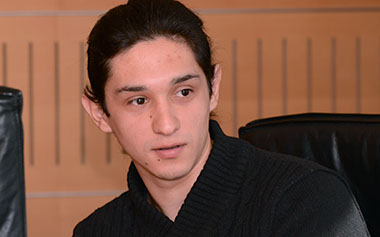
Aerobic Gymnastics is celebrating its 20th year as an FIG discipline in 2015, and after taking time to fête the occasion, FIG Aerobic Technical Committee President Mireille Ganzin (FRA) and Aerobic Athletes Representative Aldrin Rodriguez (MEX) sat down to reflect on the past, present and future of a sport that is still maturing, even at age 20.
Aerobic Gymnastics is celebrating its 20th anniversary this year. What do you think are the most significant things that have been accomplished in the discipline over these 20 years?
Mireille Ganzin: “Above all, the fact that there are more than 75 affiliated nations who practice the activity, and that we have the participation of federations from all five continents at the World Championships. There’s also the fact that many different nations reach the podiums, which proves the universality of our sport. We are also seeing vast improvement in the performances of young gymnasts. The last positive point is the inclusion of the sport in the competition programme at the first European Games in Baku (AZE) this summer.”
Aldrin Rodriguez: “The thing most important for me is the increase in the number of gymnasts who are doing Aerobic around the world at a very high level. In terms of competition, we are in some Olympic programmes including Europe, Asia, and Africa, and we are still working to be part of the Pan American Games. This sport is growing very solidly at a high level.”
Aerobic was part of the first European Games this summer in Baku (AZE). What feedback did you receive from athletes and officials on their experiences in Baku? What was the reaction of the spectators inside the arena?
Ganzin: “Two new non-Olympic Gymnastics disciplines were invited alongside the traditional Men’s and Women’s Artistic, Rhythmic and Trampoline. The staging and the mix of disciplines gave Gymnastics a completely different dimension. The format proposed will require further reflection and should be improved following the example of figure skating at its Galas. The initiative was obviously a success with the spectators, who were able to discover other disciplines, but also with the competitors included in the Gymnastics family, who had an opportunity to mix with other disciplines.”
Rodriguez: “I heard many good things from the Aerobic athletes in Baku. They said that as an event, it was a totally different experience from what they’ve done before in terms of structure, organisation, level and importance. My colleagues from other sports also told me that they were very impressed with the high level of the competition. People who have never seen Aerobic realised how complicated, attractive and strong this sport is. We definitely feel that we can reach for a place at the Olympic Games.”
In your opinion, which Aerobic gymnasts or Groups have made the biggest impact on the discipline during these past 20 years? Does anyone come to mind who really pushed the envelope, or presented something new and innovative, that took the sport in a new direction?
Rodriguez: “Well, we have many, but personally the Spaniard Jonatan Cañada changed the perspective of Aerobic Gymnastics. We can’t forget Gregory Alcan (FRA), Yuriko Ito (JPN), Kenishiro Nomura (JPN), Park Kwang-Soo (KOR) or Marcela Lopez (BRA), and every year we have many good athletes who continue to change and evolve our sport. We don’t mention the coaches very often, but they are the solid forces who create many good athletes.
“In the Group categories, where men and women often compete together and synchronicity is emphasised, and the incorporation of the new disciplines Aerobic Step and Aerobic Dance have added something extra special to the competitions and made Aerobic even more interesting.”
Ganzin: “The categories which appeal most to the public are of course the synchronised categories like Mixed Pairs, Trios and Groups. This is thanks to choreography that highlights not only synchronisation between team members, but also different formations and lifts, which we particularly focus on to make them more striking and creative.
The last two categories, Aerobic Dance and Aerobic Step, which were introduced at the Shenzen Universiade in 2011, attract an increasing number of competitors and federations and have drawn new participants to our championships. In these events, the performance leans more toward group choreography and different dance styles, which appeal to the younger generation.”
How do you plan to develop Aerobic in the coming years on different continents? Is there cooperation between continents for development?
Ganzin: “Our main concern is to carry on with the development of the discipline on all five continents amongst young people. We are also proud of being included in the World School Games and the age group competitions and training camps that we organise. Development can also be achieved through the organisation of the Academies and of judges’ courses, but also through different training and competition initiatives developed by the Continental Unions and the FIG.
Cooperation between continents is absolutely necessary. The language is above all the language of the body, the source of well-being.
The diversity of the sport adds another dimension, where people with a shared passion for Aerobic Gymnastics come together and celebrate.”
Rodriguez: “In the Technical Committee, we are always thinking about the future while building a solid present. In celebrating the 20th anniversary, we have created a programme to develop Aerobic from the ground up, with videos of Aerobic movements, basic steps, etc.
“Like any athlete representative, I try not only to receive suggestions and ideas, but to speak with the people about how we can be more present at all competitions and further develop our sport.”
Finally, could you share a personal story about something related to Aerobic that touched you personally or changed how you saw the sport?
Rodriguez: “I definitely feel empathy with all the athletes when they are happy, sad or euphoric at different moments. Something that has really touched me is when you see the complicity amongst every team and of course the friendship and respect everyone has for all who are involved in Aerobic. Even though there are rivalries, that’s sport, and this is Aerobic. In Aerobic we are a family, we are Gymnastics!”
Ganzin: “One of the occasions that made a deep impression on me took place during the finals of a continental competition where the Individual Men performed alternating with Mixed Pairs. Because of the draw, a gymnast who was competing in both categories had to perform his two routines successively. Supported and cheered on by spectators who knew how difficult it was to perform these two routines back to back, the gymnast performed both very well. The same thing happened the next day with the Individual Women and Trios.
As a result, we did scientific research on the recovery period needed after exercises. The results spurred us to create “the 10-minute rule” where gymnasts must have at least 10 minutes of rest between exercise, which has been in force since 2010.
Another thing that struck me was the extremely warm welcome of the Colombian audience at the 2013 World Games in Cali, where more than 18,000 people came out to support the athletes in a very friendly and festive atmosphere, singing Colombian songs and shouting the traditional «HOLA». All gymnasts were cheered regardless of their nationality, and everyone will always remember these moments of joy.”
Twenty years from now, where would you like to see the discipline? What needs to be done to accomplish these goals?
Rodriguez: “Well, everybody knows where we want to be. Do I dare say it? (Laughs) The Olympic Games! We must continue to work very hard, as athletes, coaches and among the Technical Committee. We also need the support of our Federations, to keep pushing to make sure Aerobic keeps growing.”
Ganzin: “The dream of the entire Aerobic family is of course to see the sport become an Olympic discipline. In the very near future, Gymnastics will very likely have to reconsider its competition system in order to better address the expectations of the spectators and the media. The European Games could be an example of it, because they presented a new format that included all the FIG disciplines. That’s why we are working to see the discipline included in the Continental Games’ programme.
“In their next edition, the World School Games will also feature Aerobic Gymnastics, joining Artistic and Rhythmic Gymnastics. This is a major step forward that will allow us to go on with the promotion and development of the discipline with the youth by creating specific programmes. In 2018, Aerobic Gymnastics will be part of the next South American Games.
“On a technical level, in the future special attention will be paid to the execution of difficulty elements, lifts and choreography as a whole.”
FOLLOW US


BACK ISSUES
CONTACT US:
FIG World of Gymnastics,
Avenue de la Gare 12,
1003 Lausanne, Switzerland
Tel. +41 21 321 55 10
Fax: +41 21 321 55 19