
EDITORIAL
BY PROF. BRUNO GRANDI
FIG PRESIDENT

A new project on Olympic qualification
It is common for any new project or policy change to cause doubts or fears. So it is with the proposed schedule for the next Olympic cycle which, after a long period of analysis and discussion, was approved by the Council of Melbourne (AUS) this past May.
The idea first emerged four years ago and, at first, aroused a lot of curiosity and interest. Over time the project has evolved while remaining true to the original concept in terms of structure, although with a number of concerns yet to be addressed. These are legitimate concerns because, when preparing to make decisions with such far-reaching consequences, we must do everything possible to get them right from the start and, above all, to be as fair as possible to all athletes around the world.
But the new qualification system is not just about concept or fairness. Our sport is facing new economic conditions and we have to respond, review and encourage its development.
The idea for the new project emerged after several internal events;
- The development of gymnastics worldwide;
- The difficulties we face in finding permanent sponsors (top sponsors) that will offer us the guarantee of long-term collaboration;
- The challenge facing all our Federations to recruit five gymnasts who can compete on all apparatus, both men and women;
- The inability of individual specialists to qualify for the Olympic Games because they have no team (although this problem was partially solved at the London Olympics). Do not forget, by the way, that prior to London, medallists from the World Championship qualifiers for the Olympics did not automatically qualify to compete at the Olympic Games.
In summary, the gaps in our regulations were too numerous to meet the more complex requirements we encounter today.
This new project was therefore established to correct those imperfections which bring about clear injustices (without it the list of all existing deficiencies would be longer), and to generate new interest towards our sport from the world at large.
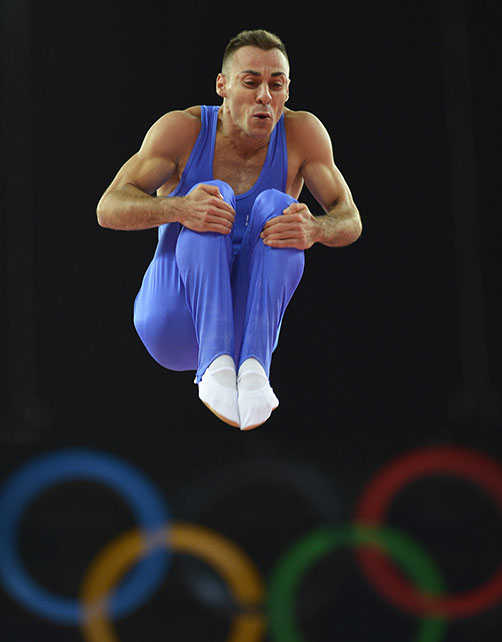
To better understand the situation, it should be noted that the number of athletes admitted to the Olympics amounts to 96 men (plus two athletes who qualify through the Tripartite Commission of the IOC and a place for the host country if it has no qualified athlete, making a total of 98). These figures are the same for women and Rhythmic Gymnastics, whereas for Trampoline, it amounts to 16 men and 16 women.
These are the initial conditions imposed on us by the International Olympic Committee (IOC) and to which we need to make some adjustments to meet our technical requirements, both promotional and organisational, in an Olympic context.
The second important point is that the IOC is firm in its demands for Universality and for Quality. Indeed one of the recommendations made by the IOC at its meeting in Monte Carlo (MON) last year was that the best athletes in each sport must compete in the Olympics.
Based on the rules that have been imposed on us, we can analyse and evaluate the project. In addition to these criteria, our review should also consider the FIG’s specific requirements listed above. There is no simple solution, so we must make rules which will suit the greatest number, work for all our Federations, and that will provide greater visibility to our competitions and attract sponsors. They should also preserve the system of team Olympic medals, individual Olympic medals and those for specialists, while respecting universality. We must keep the value of the Continental Championships, while also incorporating the competitions of major interest, such as All Around World Cups and World Challenge Cups (specialists).
It has not been easy to construct the projects in a completely logical way and it is likely that it will not meet all of the many demands that any of us may raise.
If we refuse to take into account the reality of the situation in which we find ourselves, any discussion will prove useless. Solutions for many of the issues raised have already been found, and some are about to be solved, but it will not happen without some compromises and sacrifices.
Personally, I did what was required to value all our competitions and include them in the overall context of our calendar. This will give them not only paramount importance, but also greater visibility.
To achieve such a result, however, we have had to resolve to reduce the number of athletes making up the teams.
Obviously, if the IOC had allowed us to have 110 athletes for each section instead of 98, I would never have thought to reduce the composition of teams of 5 to 4.
Before concluding, I must emphasise that the project offers many more advantages than disadvantages and that it will continue to develop our sport in the future in a way that we can already start to see. First, though, it will be necessary to gain the experience of putting into practice the first phase of implementation of the project.

FOLLOW US


IMPRESSUM
World of Gymnastics is an official publication of the International Gymnastics Federation – FIG. Three issues per year.
Publisher: FIG. © 2015.
Publication Director: André F. Gueisbuhler.
FIG Editing: Meike Behrensen; Blythe Lawrence; William Dalè; Stéphanie Pertuiset
Design and Production: Andy Medley for SportBusiness Communications
Nr 77 will be released in February, 2016.
Editorial deadline: December 1st, 2015.
The reproduction of any articles, information, pictures must be approved in writing prior to publication.
Photos: FIG Official Photographer Volker Minkus, fig-photos.com; Hedda Rumohr Berge; Andreas Merrald; Jan Christensen.
Translations: Translink; Corinne Gaudefroy; Valérie Gianadda; Mara Valazza



CONTACT US
FIG World of Gymnastics,
Avenue de la Gare 12,
1003 Lausanne, Switzerland
Tel. +41 21 321 55 10
Fax: +41 21 321 55 19