

QUICK NAV
THE PRESIDENT'S VIEW: IZMIR 2014
BY PROF. BRUNO GRANDI
FIG PRESIDENT
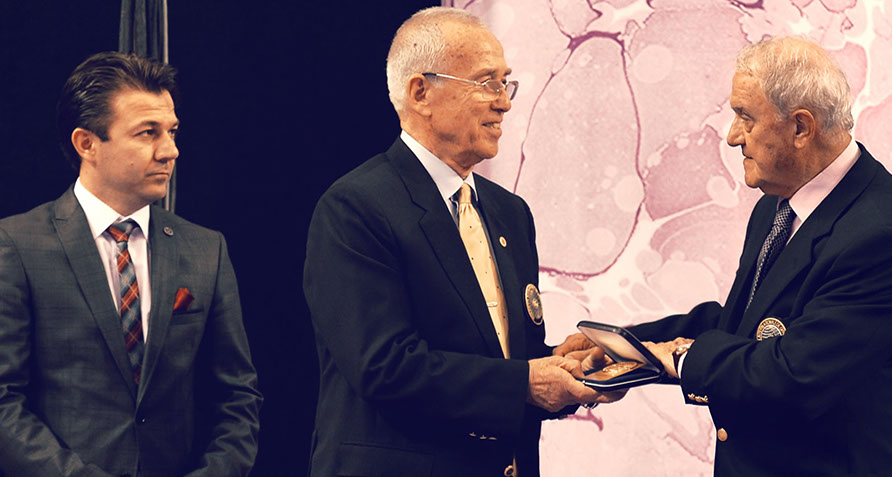
Suat Celen (TUR), Atilla Orsel (TUR), Prof. Bruno Grandi (ITA)
Finally, I had the opportunity to attend a Rhythmic Gymnastics World Championships stress-free, thanks to a collaborative relationship with the Technical Committee and judges, and the impeccable contribution of the Organising Committee and President of the Turkish Federation, my friend Suat Celen.
Thank you, Mr President.
My gratitude extends also for the ceremony held to honour my friend, Atilla Orsel, at the close of a long and shining career in gymnastics. One of the founders of the European Union of Gymnastics as well as Vice-President and Executive Committee member of the FIG, Atilla Orsel presided over the Turkish Federation for many years.
The ceremony was simple but efficient, held at the competition venue and celebrating – in my own terms – gratitude and reconciliation. It was placed just prior to the medal ceremony and in the presence of the numerous spectators and Federation leaders he has served for so many years.
I also gave a brief report on the unperturbed days we experienced to the Technical Committee at our post-championship meeting.
The Russian school is certainly leading the pack, and I would like to give particular mention to Yana Kudryavtseva, whose every gesture appeared flawless.
The shape, figures, lightness, and elegance borne of her movements sparked an almost transformative experience. This is gymnastics. It is a sport meant to transcend the viewer as the athletes evoke feelings of exaltation in absolute beauty. All this unfolds in perfect harmony with the music and in a framework of utter beauty, reminiscent of all things artistic.
This should be the starting point for judging Rhythmic Gymnastics, based on perfection.
Many other beautiful and interesting athletes presented exceptional work, and they too deserve the best reviews. Because of them – when rhythmic becomes art as in the hands of Yana - Rhythmic Gymnastics is a sport worthy of appreciation, a complete sport. And when it reaches this level of perfection, the discipline deserves respect, not denigration. The code of points is meant to be an evaluative instrument for real technico-expressive value whereby we must be able to give an honest and veritable evaluation of each athlete.
The entertainment value of the competition - if indeed we are talking about a real show – could be increased if we make the length of the competition more realistic, more humane for judges and spectators.
As for Group competitions, these are always spectacular, peppered with speed, vivacity, and panache. What was once reserved for the Italian school has now become common practise for the best teams.
In our day and age, this approach to gymnastics, which is more beautiful and more spectacular, has opened new horizons for many, as competition results continue to grow more uncertain, more interesting and more spectacular.
It is evident that as soon as the very first mistake is made, even the best teams are penalized. There are no longer acquired results for anyone, and this makes the competitions more interesting from a sporting perspective.
The group from Bulgaria won the All-around competition, while Belarus was the most consistent team, the most confident in all events.
In that which concerns music, we are currently working with Maestro Lasse Nettum (NOR) and an experimental jury, which we hope will have a positive impact.
Music, or more precisely rhythm, is the philosophical principle on which Rhythmic Gymnastics rests in its original state; it is a necessity, not an option. We will repeat our experiment next year.
The code is the weakest link in the discipline because it does not enable us to evaluate the real, material value of the exercises. The steps taken to rectify this situation have shown signs of improvement but what has given me the most hope is that both the Technical Committee members and the judges are now aware of the problem. The criticism formerly expressed was justified!
The worlds wrapped up on a positive note, and today we continue to work toward changing the concept of the code in terms of value and difficulty evaluation.
My sincere gratitude to Vice-President Slava Corn for all her work over the past two years, not least of which has included tests, assistance, encouragement, and suggestions to Technical Committee members.
BACK TO QUICK NAV
Suat Celen (TUR), Prof. Bruno Grandi (ITA), Mehmet Baykan (TUR), Akif Çağatay Kılıç (TUR)
NEXT UP: REVIEW - NANNING 2014...

FIG World of Gymnastics, Avenue de la Gare 12, 1003 Lausanne, Switzerland
Tel. +41 21 321 55 10
Fax: +41 21 321 55 19
IMPRESSUM
World of Gymnastics is an official publication of the International Gymnastics Federation – FIG. Three issues per year.
Publisher: FIG C 2015
Publication Director: André F. Gueisbuhler.
FIG Editing: Philippe Silacci; Meike Behrensen; Blythe Lawrence; William Dalè.
Production: SportBusiness Communications
Design and build: Andy Medley
Nr 75 will be released in June 2015
Editorial deadline: 1st April 2015
The reproduction of any articles, information, pictures must be approved in writing prior to publication.
Photography: FIG Official Photographer Volker Minkus, fig-photos.com, IOC.
Translation: Allison Zurfluh, Corinne Gaudefroy.

BACK ISSUES
CONTACT US:
